Showing posts with label yellow-billed magpie. Show all posts

Thursday, July 11, 2013

CALIFAUNICATION

If you're ever in the position of owning your own island, or a ferry service to an island, and you want some extra cash, you should come up with your own species of bird. Getting a new bird on the ABA list is a sure-fire way to attract every list-obsessed birder in the US. 


I don't actually own my own island, or a ferry service, and I don't even have my own bird yet (still working on splitting the American Robin into the Hayward's Thrush, found only in north Cambridge.) But I do own a year list and I'm in Santa Barbara, which means today we're heading to Santa Cruz Island to see the Island Scrub-jay. Until recently this Channel Island bird was a more expensive version of the widespread Western Scrub-jay. When the latter was split in 1998 into 3 species (Island, Western and Florida) suddenly this island entered the birding circuit. 

Santa Cruz is about 20 miles off the California coast. The ferry service (run by the excellent Island Packers) takes about an hour and a half - plenty of time to get some decent sea-watching in. Elegant Terns were abundant around the harbor, and once we get into the deeper water, we started seeing large numbers of Sooty Shearwaters stream by:

Sooty Shearwater - brown above and below, with indistinct white underwings.

Much less common were the Pink-footed Shearwaters mixed in - larger birds with slower wingbeats...

Pink-footed Shearwater

As we were nearing the island, we had great views of a Cassin's Auklet right next to the boat, and a pair of black and white Scripp's Murrelets that flew in front of the bow, and then dove, exposing their bright white underwings. These Murrelets are more common here in spring (they breed on the islands) and I really thought I'd missed my chance. Thankfully not. Definitely a woo-hoo moment!

We arrived at Prisoners Harbor on the island at 11am and "debarked". Really? Does that mean when we get back on board we "bark?" When did disembark become too many syllables? Anyway, whatever the verb, as soon as it moved from the present to the recent past, we started hearing the upslurred "tsee-weep" of the Pacific-slope Flycatcher. It's the only flycatcher on the island, and probably the commonest bird we heard all day.  


Pacific-slope Flycatcher. Yellow belly, tear-drop eye-ring.

And it wasn't too long before we started hearing jay noises, and we were soon rewarded with great views of our target bird: the Island Scrub-jay...


Island Scrub-jay. Est. 1998.

The jay is slightly bigger than the mainland Western Scrub-jay, conveniently supporting the "Island Rule" (or Forster's Rule) which states that on islands the smaller species evolve larger bodies than their mainland kin (due to less predators) while the larger animals become smaller (less food sources.) I'd already seen this "Island Gigantism" on the Pribilofs earlier this year with the Rock Sandpiper and Gray-crowned Rosy-finch - both much larger than their non-island versions.

The famous example here of the opposite - "Island Dwarfism" - is the Channel Island Mammoth (or Pygmy Mammoth) which was only about 5.5 ft tall compared to its ancestor the Columbian elephant of 14 ft. I was very excited to finally meet an elephant that was shorter than me, but I narrowly missed the animal on today's trip by about 13,000 years.


Santa Cruz - a quick search confirmed it as an elephant-free island.

I was only on the island for 3 hours - which apparently wasn't long enough on the evolutionary time-scale for me to become larger or smaller.

We arrived back to Ventura with enough time to try for the Yellow-billed Magpie for a third time. But this time we went to Happy Canyon Road, which not only sounds like a much nicer place than Los Alamos Park, but looks much nicer too...


Happy Canyon Road - Santa Barbara County

But really the most important part of this comparison is that Happy Canyon Road actually *has* Yellow-billed Magpies. After 5 minutes of driving, we started seeing them fly across the road, and even sit on farm buildings...
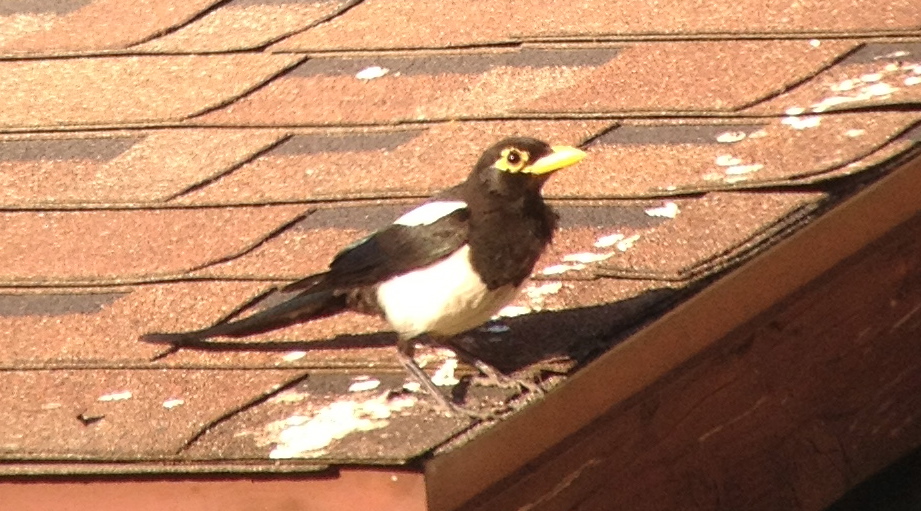

Third time lucky. Yellow-billed Magpie. (Very) Happy Canyon Road.

Phew! We celebrated with a great meal in Santa Barbara, and prepared for the next day: birding in Los Angeles. The city has its own version of the Island Rule: compared to their mainland ancestors the inhabitants tend to have larger lips and egos together with shorter attention spans and abilities of walking more than half a block.

+ + +

BIG YEAR LIST: 671 + 1 provisional species.

NEW YEAR BIRDS (7): Elegant Tern, Sooty Shearwater, Pink-footed Shearwater, Scripp's Murrelet, Island Scrub-jay, Yellow-billed Magpie, California Quail

Wednesday, July 10, 2013

CALIFORNIA BIRDIN'

Today (Jul 10) is day #1 in a joint birding / muggle vacation with Gerri. The plan is a grand tour of (mostly) Southern California stopping along the way to pick up all the California endemics, and at the same time, avoiding getting stranded in the desert / ending up on a Hollywood reality TV show / getting pumped full of Botox.

Here's the route plan:
  • SFO to Santa Barbara via Highway 1 and Hearst Castle
  • Santa Cruz Island
  • Los Angeles (Palos Verde, Huntingdon Park)
  • San Gabriel and San Bernadino Mountains
  • Salton Sea
  • Kern County
  • Sequoia National Park and Yosemite
  • San Francisco and Wine Country
2,500 miles in 10 days. Compared to normal Big Year Birding this really is a vacation!

Our first day is fairly straightforward: get to Hearst Castle before it closes and then find a Yellow-billed Magpie.  Along with Island Scrub-jay, the Magpie is a true California endemic - never having been recorded outside of the state.

It's Gerri's first time to Northern California which means we're driving down Highway 1. If you've ever driven this route before, you'll know (1) the scenery is breathtaking; (2) it's very easy to drive off the side of a cliff because of (1); and (3) - finally a birding reference in this otherwise not very birdy post - it's possible to spot Condors here!

Highway 1 - where it's hard to keep your eyes on the road...

While Gerri is busy taking pics of the coast and cliffs, I'm taking care of activities 2 and 3: scanning the sky for Condors, and keeping the car on the hairpin road. We're driving south of Carmel and Monterey, with cliffs on one side, and a thin stretch of road holding us out from the Pacific way down below us on the right. Plenty of Turkey Vultures teeter-tottering in and out of the fog. And then - as we round a bend in the cliff - we both shout out, "Condor!" A huge bird of prey is flying straight at us. And then another. In profile, the ridiculously long wings reach out to the horizon, finally ending in splayed feathers giving the impression of long fingers. We find a place to pull over and watch as the two young Condors effortlessly glide above us dwarfing the accompanying Turkey Vultures. As the fog rolls in and the cliff disappears, so too do the birds. And that's when we notice an adult perched in a dead tree up the cliff from us...


Adult California Condor
Notice the red head which is entirely unfeathered. 

Condors are pretty cool! It's our largest land bird (its wingspan of nearly 10ft is only beaten by the Trumpeter Swan.) Related to vultures, Condors feed by scavenging on carrion. Once found across the country all the way to Florida, by the 1980s it was on the verge of extinction - due to habitat loss, lead and DDT poisoning as well as poaching. A controversial Recovery Plan involved capturing all the remaining wild birds and bringing the species into captivity. On Easter Sunday 1987 the species was officially extinct in the wild - the day the last wild bird was captured. From just 22 birds a captive breeding program in San Diego and Los Angeles zoos was successful enough to gradually release birds back into the wild - in California, Arizona and Baja California. At the same time the Ridley-Tree Condor Act was passed requiring hunters to use non-lead bullets in the release zones. This combination has been a success: there are now over 200 birds in the wild. And the birds we were lucky enough to see, like all today's Condors, are descendants of those 22 captive birds. Unfortunately, since they're a recently-released bird, they're not on the ABA countable list (they're still a Code 6 - extirpated from the wild) which means I can't count them. It may not be on my Big Year list, but it is on my awesome birding experience list (which is much more important.)

Further down the coast, Hearst Castle reminds me that I don't have enough medieval ceilings in my apartment or even a movie theater. And, since no-one's probably reading this, I can even admit to not owning a Roman mosaic floor. Yikes.


Hearst Castle

We trade the opulence of William Randolph Hearst's palatial ranch in the country for a tiny little park south of San Luis Obispo. Los Alamos County Park is home to the Yellow-billed Magpie. That's what the guide book says, and that's what the annoying local muggle says too, "yeah - they're here all the time." Really? So where the hell are they now then? Clearly, *not* here "all the time." We walk around, adding Oak Titmouse and California Towhee to the list, and trying not to be too distracted by the clown-like Acorn Woodpeckers. We stay until the sun slowly slips below the horizon and the Yellow-billed Magpies continue with their excellent impression of a bird that is decidedly *not* here all the time.

Rather than spend our first night as planned in Santa Barbara, we (reluctantly) elect to stay near the park in a motel in a town with no restaurants (and no magpies!), and try again for the Magpie in the morning - before getting the boat to the Channel Islands. 

So far we have a bird we can't count (Condor), medieval ceiling envy, and a very early start to day 2. A start that annoyingly again does not involve any Yellow-billed Magpies. 

Los Alamos Park: home to the Yellow-billed Magpie (except for at least 4 hours a year when they decide to go on vacation.)

+ + +

BIG YEAR LIST: 664

NEW YEAR BIRDS (2): Oak Titmouse, California Towhee 
[California Condor - not countable as only recently reintroduced into the wild (Code 6)]